Day 3 Thursday 17 August Trient to Champex

I have not slept well in the Gites. I Do not know why, I never had any trouble before. Once again the dortoir was full. This one was a little more basic, pairs of mattresses side by side on bunk beds. My mattress mate was a French woman, so no communication was possible. Lest you think anything salacious occurs in these establishments let me re-assure you it doesn’t. We all have sheet sleeping bags (in my attempt to save weight I bought a silk one, v v comfortable). We then have a duvet each. The pillow is rubbish, maybe that is why I can’t sleep.

At 6am people start to get up and pack their rucksacks ready to start straight after breakfast. I was on my way by 7:30, heading in the other direction to the TMB walkers who usually circumnavigate the mountain in an anti-clockwise direction. The church was outlined by the Trient glacier

I walked through the village and crossed the road to start the climb up to the Col de la Forclaz. The track was the original ox road between Trient and Forclaz. It cost 4,100 francs to build. In 1912 cars were allowed on the road, but only at certain time and not at night. They were limited 18kph except when going round corners or through villages when they at to travel at the pace of a horse’s step.

I reached a path junction and had to decide which way to go. I chose the easier (Bovine) route rather than the Fenetre that I alluded to in yesterday’s blog, partly to protect my knee and partly because rain was forecast for the afternoon. Visibility would have been poor. I continued up to the Col de la Forclaz alongside a bisse, which is a man made stream used to divert water from a glacier to a village or for irrigation. There was a good view down to Trient.

From the col the path continued through climb through meadows and woodland. There were good views down to the Rhone valley in the distance with Martigny in the mid-ground. In the distance mountain tops could be seen peeking above the cloud inversion.
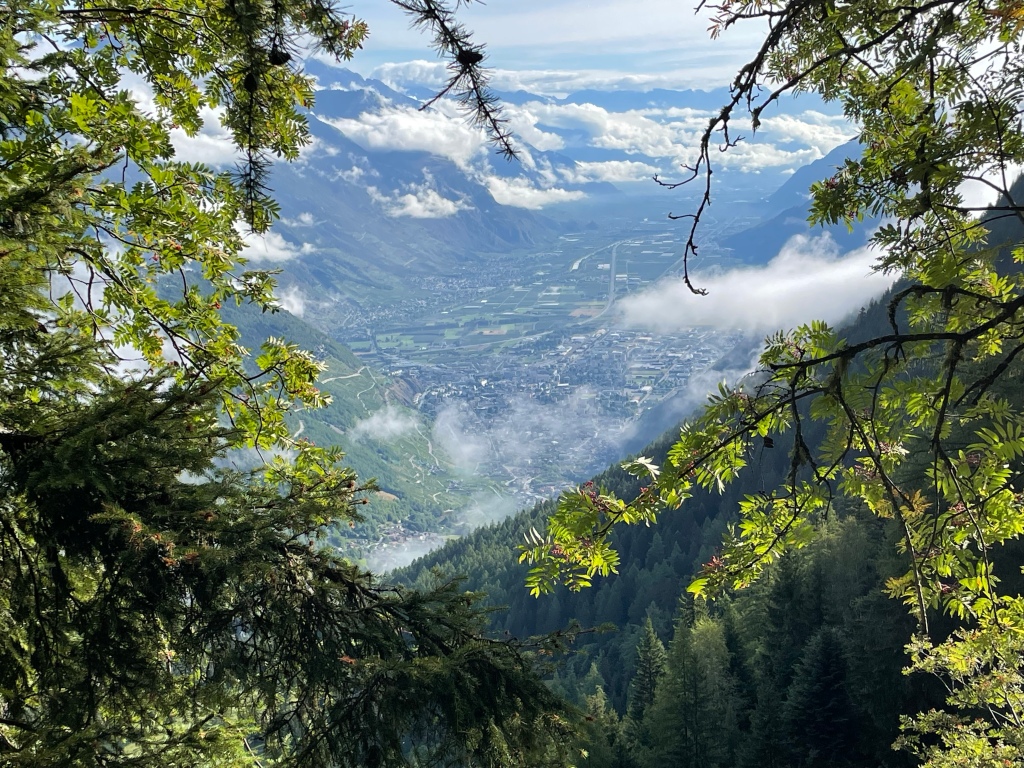
The path now went through woodland on the north slopes of the Croix des Prelayes climbing, usually with a moderate gradient, up to Alp Bovine. The view down to the Rhône valley was often visible through the trees. I came to a clearing in the forest and it was obvious that the cloud base was thickening and descending. I re-entered the trees, climbing more steeply now. Martigny and the adjacent farmland could be seen through a gap in the trees

I emerged from the forest at Alp Bovine, the highest point on today’s walk at 2049 metres. Down below, in the pasture land was the building of Alpage de Bovine and in the distance I had my first view of the sniw covered Gand Combin massif.

I descended to the hut and had apple pie and coffee.

The owner was impressed that I could speak some French. Now, my French is pretty awful so that must mean most English speakers do not even bother to try. A cow bell had been recycled

Presumably it clangs at dawn rather than crows. By the time I had finished eating the tops were all in cloud. I set off hoping to reach Champex before the rain that was forecast for late afternoon. The next group of walkers to come up the hill and pass me were from Saudi Arabia, a truly international day. I re-entered woodland and began to descend steeply. My knee tolerated this much better than yesterday, even though it was another long descent.

I crossed two waterfalls but managed to keep my feet dry. Eventually the path became a farm track. Just below the farm I took a path that climbed gently through woodland to emerge at Champex d’en Bas. I walked through this village and then began the gentle climb along road to Champex d’en Haut

The refuge was at the top of the village. Another international evening was spent eating fondue with two South Africans, one of whom now lives in Neufchâtel, and a man from the Chinese/North Korean border who lives in Singapore. After dinner it was time to struggle with today’s Wordle (twang!) with a group of Americans.

Day 2 Wednesday 17 August. Montroc to Trient

Gites in mountain areas are geared for an early start. Breakfast is usually served starting about 6:30, ideal as you can do a lot of the day’s climb before it gets too hot. Today there were fresh croissants, a welcome surprise, French bread and cheese, jams and marmalade. Everywhere has blackcurrant jam, I guess it’s what is left after the tarte aux myrtlles served up during the ski season. Last nights meal was good too: tomato salad, vegetarian risotto with local cheese and caramelised apple tart.

I left the gite and walked up the road to Le Tour. I was reminded of the other danger of living in the alps. There was a memorial to 12 people killed in an avalanche in 1999, five were from the same family, presumably their house was in the path of the snow.

Le Tour is the road head for one of the ski area in the Chamonix valley. The ski terminal was a hive of activity as they are modernising it. The lift has been removed and there were large reels of cable. I would have liked to have watched them load it on to the support towers but I had a walk to do.

The path started under the towers and zigzagged up the hill. There was a field of cows to one side so I was accompanied by the sound of cowbells, one of the things I really like about alpine walking. I gained height quickly and was rewarded with a view back to Le Tour, Montroc and the Chamonix valley

As I approached the middle station of the lift at Charamillon I could see my target, the Col de Balme in the distance

It is steeper than it looks from the photograph, there is a 750metre difference between Le Tour and the col. as I dragged my way up the hill I was reminded of the flyers I have seen (and would continue to see) for the ultra TMB race next week. About 2500 runners will do the TMB (or part of it) next week finishing in 32-48 hours, the record is about 20 hours. Most walkers take 10-14 days to complete the 170km circuit. If 170km is not enough for you there is a 300km non-competitive run as well.

I arrived at the col at lunchtime in lovely sunshine. The col is at the border of France and Switzerland. Only a sign marks the border. Have the Scots thought about border control if they get independence? There are two signs marking the border, the French have measured the height of the col as 13 metres less than the Swiss. There is a Chalet-refuge on the col precisely on the international border.

Chalet-Refuge Col de la Balme

It’s nationality has been debated over the years by the French and Swiss. I don’t know who owns it at present but the entrance door is in Switzerland but they prefer euros at the cash desk. I had lunch with me but the food there looked nice. I did buy a slice of chocolate cake though.

I settled down to eat and admire the view. The Aguilles Rouge were spectacular

The Drus could be clearly seen but Mont Blanc summit was covered by cloud

I set off down the mountain into Switzerland. Route finding is rarely a problem. All the footpaths are signposted with their destination and the approximate time it takes to walk there. Once you have been walking for a couple of days you know how to adjust the suggested time to your actual pace. National trails are marked with a red and white striped logo, usually painted on the rock but here it was a metal sign.

The haute route is not an actual long distance path but it uses parts of others, the TMB being one. The initial descent from the col was easy and gentle. I soon arrived at a collection of buildings called Les Herbageres.

Now the descent became steep. Despite my walking poles my knee began to hurt and, worryingly, it felt like joint pain rather than muscular. I just took it slowly and kept stopping.. I found this very depressing as there are steeper descents to come. On the way down I met a German who checked I was OK. He is also doing the Haute Route. We are walking similar stages so I hope I will see him later in the week.

Eventually I came into a clearing and I could see Trient in the valley below.

I re-entered the forest. To my surprise, at intervals, there were barbecue kettles adjacent to the path. I would have thought this would be too much of a fire risk with dry wood and pine needles around but the forest hasn’t burnt down and the Swiss are noted for their safety first approach.

As I got down to the valley floor I could see the valley that leads to the fenetre d’arpette. It is steep and narrow at the top and from here I could not see a feasible way up.

I arrived at the gite. As last night it was very busy. The TMB is recognised world wide as a good walk but I was surprised to see the number of Americans who are walking the Alps. I shared a table with a group from California and a couple from Hong Kong. The man from Hong Kong had studied architecture at Manchester University in the 80’s, it’s a small world.

Day -1 Sunday 14 August

My second walk of 2022 is the Walkers Haute Route from Chamonix to Zermatt. The original Haute Route is a high level route that crosses glaciers and so requires mountaineering experience or a guide. There is also a winter ski mountaineering route that is way put of my ability. The walk I am doing crosses lower passes, keeping below the summer snowline, but is meant to be one of the more spectacular Alpine walks. It runs from Chamonix to Zermatt, so starts at the foot of Mont Blanc and ends just below the Matterhorn, two iconic mountains. It is still a fairly high level route, the highest pass reached being about 2900 metres above sea level. It is a fairly tough walk, crossing 11 passes and involves a total ascent of over 10 000 metres. Some days I will descend to valley inns or gite d’etape, others I will spend in remote mountain huts. The climax involves the crossing of a 500 metre long suspension bridge, high above a ravine on the Euroweg.

No technical experience is necessary but some of the route is weather dependent and I know part has been rerouted due to rockfalls during the spring melt in 2022. The first 3 days are shared with the Tour du Mont Blanc that I walked in the 1980s. I am hoping for good weather. On the TMB we had to avoid the Fenetre d’Arpette because of storms and this is meant to be a dramatic pass

When I returned from the Offas Dyke path my knee was not in good shape. I couldn’t fully bend the joint and I was being woken at night by discomfort. I saw a physio (Trish) who advised getting an x-ray to make sure there wasn’t anything structural that would preclude rehab exercises. I was very disappointed that it showed a lot of OA change as well as loose bodies. |I spoke to an ex-colleague, Waqar, who is a musculoskeletal radiologist. He advised and kindly preformed an ultrasound and MR scan. It did not look good, there was a loose body which was preventing me fully flexing the knee and he thought I may need arthroscopy to disimpact it. I certainly could not have walked 120 miles across mountains on it at that time..

The following night I was woken by pain in the knee. I must have tried to curl up into a ball and dislodged the offending bit of cartilage. I could bend the knee most of the way. I was still very pessimisitic of going, particularly as I had planned several more walks to keep mountain fit and I was now limited to rehab.

Thanks Waqar, Trish and Connor (my PT). The pain settled with rehab. Last week I walked up Jacobs ladder, across Kinder and down Grindsbrook so I can do steep ascents and descents, although the Alpine climbs will be more sustained. I am moderately confident about doing the walk. It is possible that I will need to break my usual rules and use valley buses or cable cars to rest the knee, we will see.

Day 14 Monday 27 June Bodfari to Prestatyn

The final day! I stayed at LLetyr Eos Ucha, a small B & B outside Bodfari.  Very nice stay, half way up the hill out of Bodfari, there were good views from my beroom window to the south.

The weather forecast was not good and it was raining when I woke up. By the time I set off the cloud was breaking up and the sun was trying to shine through. I thought that today would be an anticlimax after the moorland ridge I walked along yesterday. I was reassured by the couple staying at the B & B that it was an interesting days walk and indeed it was.  I was mainly walking through farmland but there were still some hills to cross with good views.

I set off steeply up a field to reach a lane at the halmet of Sodom. There were good views of Snowdonia to the west and, further north, I could see the sea.   I followed a road uphill past the wood of Sodom Culvert before turning off to a path through fields that crossed the shoulder of Cefyn Du.  Here I could see the limestone spire of the marble church at Boddelwyddan  glinting in the sunlight. 

There were workers on the path with strimmers trimming back the bracken. The cloud continued to lift and I could soon see Prestatyn in the distance as well at wind farms out in the Irish Sea.

The path continued to undulate and I could hear traffic on the A55, the main road between Merseyside and Anglesey well before I could see it. The cloud lifted a bit as I crossed the shoulder of Moel Maenfa and I could see the Snowdon range to the West. I crossed the road on a footbridge and followed a lane to the village of Rualt.

Snowdonia from above Rualt

After walking through the village I took a path that climbed steeply alongside a wood and then across fields over the shoulder of Mynydd y Cwm.  As the path started to descend there was a father and son dismantling their tent.  They were walking Offa’s Dyke and then, after a short rest, were heading on the coast path around west Wales back to Chepstow, an extra 1000 miles.  They had minimal kit.  It looked like they were sleeping in a festival tent that was held together by safety pins.  They were the complete opposite to me, no planning, they would just walk until they were tired and then pitch the tent.  If they passed somewhere that sold food they would have a hot meal otherwise dinner was cereal bars.

I left them to pack up and continued to a road.  I crossed more fields and then ascended over the shoulder of Marian Ffrith. Here I could clearly see the sea and the offshore wind farms.

The path continued through farmland and over another low hill.  I descended into the  Fyddion valley at the site of the Felin Fawr flour mill, the old axle of the waterwheel still visible..

A mill was recorded here in the Domesday book. In the 19th century there were seven mills in this valley using water power for the production of flour or cloth.

As I crossed a road to head towards Craig Fawr, the most northerly hill of the Clywdian range Jonathan caught up with me. We walked for a short distance before he went ahead at the start of the final, steep, climb up on to the Prestatyn cliffs. There were good views over the Irish sea and Snowdonia and the Great Orme could be seen to the west.

Looking west towards Rhyll. The Great Orme and Anglesey can be seen in the distance

Prestatyn is a modern town and the sight of a Tesco superstore and an M & S were perhaps a mundane end to the walk.  I descended from the cliffs into a residential part of Prestatyn before heading down the main street to the monument marking the end of the walk and a celebratory raspberry ripple and white chocolate ice cream.

End of trail marker, Prestatyn

This was a good, enjoyable, walk.  There were some really good ridge walks over high ground with spectacular views.  The paths were not busy so I never felt I was on a route march.  I enjoyed the woodland sections as, usually, they were natural forests with a good diversity of plant life rather than the sterile conifer plantations.  There was quite a lot of farmland.  This made life difficult for me as my knee got more painful and difficult to bend as I went along so stiles became a bit of an ordeal.  Sales of ibuprofen soared!  The B and B and pubs I stayed in were very nice.  There was usually somewhere to buy food at the start of each day’s walk but the borders are sparsely populated and places to get lunch en route were the exception rather than the rule.

I did the walk because I had never visited the Welsh borders and I was not disappointed. Part of the reason was as a training exercise before tackling the Haute Route later in the summer, I had already been to Scotland in May and was planning another short trip in July.  However, just before I started Offa’s Dyke I twisted my knee and walking 177 miles on an injury was not a good idea.  Investigations showed OA and a PCL strain which has taken about 6 weeks to settle down and, as yet, I have not tested the knee on the hill since I returned from Prestatyn.

Day 13 Sunday 26 June Ruthin to Bodfari

I returned to ODP along the lanes and the farm track that I descended yesterday and continued up the path to Clywd Gate, the site of an old tollgate. I followed the road for a short distance and then climbed across farmland to pass around Moel Eithinen and reach the main ridge of the Clwydian mountains. There were good views back along the ridge that I had followed yesterday.

I contoured round the hill fort on Foel Fenli with good views down to Ruthin.

Ruthin from Foel Fenli

Ruthin would dominate the valley for several miles. The weather forecast was not good and I could see showers all around but fortunately they all missed me. I descended steeply to a car park at Bwlch Penbarra and suddenly there were a lot of people! This was a shock to the system after walking in virtual solitude for the best part of two weeks.  Moel Farnau and its Jubilee Tower are a popular day walk and, despite the inclement weather and high winds, day walkers were out in force.  I followed them, up to the summit of Moel Farnau.

descending to Bwlch Penbarra with Moel Farnau in the background
Jubilee Tower, Moel Farnau

The Tower was built in 1810 to commemorate the jubilee of George III. It was never completed and, after it was damaged by a storm in 1862, it was reduced to the base as it is today.

It was extremely windy on the top of the mountain which is the highest peak in the Clywdian range. I sheltered in the lee of the tower to have lunch. The view was limited by the low cloud.  Liverpool could be seen to the east and I thought I could see the South Peninnes in the distance. It was cold stopping in the high wind so I soon set off, descending to the west, before turning north again to follow the ridge over several lower tops. Ahead of me was Moel Arthur with its bronze age hill fort on top.

I saw no point in climbing to the summit today so contoured round the upper slopes. I should have had a good view of Snowdonia but it was shrouded in mist.

There was now a steep descent to another road and carpark before a further steep ascent on the edge of woodland up to the summit of Penycloddiau. On top of this hill is one of the largest hillforts in Wales. It dates from the iron age and the ramparts and ditches are clearly visible. (The article about the fort on the Clywdian web site depicts an extended iron age family enjoying a picnic; I think this is a very idealised picture of what life must have been like then).

I had my first view of the sea.  The Great Orm of Llandudno could be seen in the distance. I am nearly there. 

Bodfari and the Irish sea from Pennyclodiau

There was now a long descent to Bodfari.  The path dropped steeply to the hamlet of Aifft. It then climbed over the shoulder of another hill before descending to a road.  I had not bothered to look at the map for a bit and I thought I was nearly here.  The only building at the road was Grove Hall, which used to be a residential home and I still had another mile to go.  Finally I reached the main road at Bodfari where there was the sad sight of another closed pub.  It was by now about 6:30 pm and my B and B was about half a mile further uphill along the path towards Prestatyn.  I telephoned them to say I would be late and headed into the village centre and the Dinorben Arms where I had a really good roast dinner and beer.

Day 12 Saturday 25 June Llangollen to Ruthin

This was a long day as I had extra mileage to rejoin the ODP and a long detour at the end to get to my B and B in Ruthin.  The day started fairly brightly.  I bought some lunch and crossed the river Dee and climbed uphill back to the Path.

River Dee Llangollen

I circled uphill around to the north of the Castell Dinas Bran to get back to the Panorama walk. I followed the road for about two miles. Thre were good views across the Dee valley and the cliffs of Eglwyseg mountain ahead and to the right.  The road followed the coutour to keep below the scree slops.  Eventually I took a narrow stony path that continued below the scree and subsequent cliffs. 

Leaving the road on the Panorama Walk

After a further couple of miles it dropped down through a wood to rejoin the road at World’s End. I have been unable to find out how the valley got its name.

World’s End

I climbed steeply out of the valley along the road and followed it for about a mile and a half across open moorland.  There was thick cloud overhead but the rain held off and, as I turned on to a path consisting of stone slabs to cross the moorland, the sun came out. As I arrived at Llandegla forest I could see the Clydian mountains to the North, the final barrier between me and the Irish sea.

Unlike most of the woodland I have walked through this trip, the Llandegla forest consists of conifers arranged close together.  The trees are farmed for the paper industry and there had been some harvesting of the wood so there were quite a lot of clearings with some views.  I passed two girls and their teacher.  The girls had huge packs and were doing a D of E expedition, I am not sure how much they were enjoying it!  A little further on I met another teacher on her way up the hill looking for the group. The forest is an extremely popular site for mountain biking. The trails are well organised, the walking and biking trails have been kept separate as much as possible and there are warning signs for walkers when you are about to cross a bike trail.

As I emerged from the wood it began to rain, heavily at first. I descended across fields to the village of Llandegla. There is a holy well, St Tegla’s well, in the village whose waters are said to cure epilepsy. I had my head down in the rain and I missed the turn to it.  There was a village shop with tables outside, I decided not to stop as I had lunch with me.  Big mistake! Apparently there were tables inside and they served excellent home-made mushroom soup.

The path now entered farmland.  There were odd bumps in the fields that I understand are due to limestone outcrops. Two women passed me (who told me about the soup) who were running(!) the ODP. 

The rain stopped but it remained overcast. The path crossed a stream and climbed uphill to join the Clydian Mountains. I followed a road for half a mile and the joined a service track that led to a radio mast  on the side of Moel y Waun. 

Looking north along ODP from Moel y Gelli

The track became a delightful path that went over the shoulders of Moel y Plas, Moel Llanfair and Moel Gyw. I could see Ruthin in the valley to my left. After Moel Gyw the path descended to a farmhouse at Pen-yr-allt where I left the ODP for a rather tedious 3 miles descent along farm tracks and lanes into Ruthin where I stayed at Sarum House. This was a lovely Georgian townhouse in the centre of Ruthin, well worth the detour.  The owners, John and Helen, were perfect hosts. Helen is a keen cyclist and told me that before she settled down she cycled to Istanbul with a friend of hers. Quite an adventure!

Ruthin is an attractive medieval town. I was staying in the centre, near St Peter’s Square.

St Peter’s square Ruthin

Day 1 Tuesday 16 August. Chamonix to Montroc

It is not every day (at least in Manchester) where you go out of the front door and see a glacier above you. I was also not expecting to see about 20 hang gliders swooping round above the valley.

Room with a view

I walked into the Chamonix for a coffee and a rather nice pastry (filled with lemon custard). I then had a wander round the centre of Chamonix which was rather nice. Yes there were a lot of ski shops, which were concentrating on walking, climbing and mountain biking as it is summer but there were some nice old buildings as well.

Chamonix is a slightly uncomfortable mixture of the old and new. It claims to be the original centre of modern mountaineering . The first ascent of Mount Blanc was made from here in 1786 and is commemorated by a statue of Jacques Balmat, who was the first to climb the mountain, with Horace-Benedict de Saussure who put up a cash prize for the successful climber

A short distance away is a statue of Michel Passard who made the first ascent with Balmat. The street is named after Edward Whymper, an English mountaineer who lived in Chamonix and was the first man to climb the Matterhorn (four of the party were killed during the descent).

I left Chamonix by walking alongside the l’Arve river initially through the town and then a municipal park and sports area before entering woodland called le Bois, I wonder why.

The path began to climb steeply. My original plan was to descend to Le Lavancher but as I stopped to check the map a lady suggested I continued up to Le Chapeaux as there was a spectacular view of the Mer du Glace and the Grande Jorasse. As it was early I thought this was a good idea, although it added 6km of distance and 200 metres of ascent. It was worth it but I was horrified to see the amount that the glacier has retreated over the last 25 years.

As recently as 1995 the glacier extended as far as the lake at the bottom of the picture.

There were also good views down the Chamonix valley, I didn’t realise how built up it is from the valley floor.

I retraced my steps back down the mountain and worked my way through the chalets of Le Lavancher . I now took the petit balcon sud path which climbed high above the valley. Initially it was a farm track but it soon became a narrow path winding through the trees. It was a bit disconcerting here as the path is shared with cyclists but there were no mishaps. Every so often there were small clearings and the Aguilles Rouges could be seen across the valley.

I dropped down to the northern end of Argentiere to get a cold drink. I returned to the path through the churchyard and it was sobering to see the first two graves were of Brutish climbers who were killed in the 1920s. Ice climbing is still a very dangerous sport, even with modern equipment.

I now had a steep climb up to the chalets of Les Frasserands and Montroc where I was staying in a gite. These are the equivalent of an English youth hostel but are privately owned. Gites, and mountain huts, offer dormitory type accommodation but unlike in the UK the dormitories are mixed. Most provide an evening meal, always tasty and filling even when you are halfway up a mountain.

One of my roommates, Richard, is a Korean, now living in the US. This is his third trek of the summer, in the US and Europe. He is doing Tour de Mont Blanc so he has nearly finished, the Haute Route follows the last few days of the TMB route.

Day 11 Friday 24 June Chirk to Llangollen

This was a short day today. There were some sunny intervals this morning but rain came in during the afternoon.  I rejoined the ODP by following a road to the Chirk Castle estate.  The 18th century gates are rather ornate.

The castle was commissioned by Edward I to defend the land he gained by defeating Llewellyn the Last.  He granted it to Roger Mortimer who was made Justiciar of Wales by Edward II.  Edward II  became very unpopular with his Court when, it was claimed, Hugh Despenser (his favourite) had too much influence over him and his policies. Despenser also got involverd in several disputes over land with other Marcher lords. Mortimer, leading the Marcher lords, took up arms against the King but was eventually defeated and thrown into the Tower of London. Aided by a guard, Mortimer and his nephew, Mortimer of Wigmore, escaped and fled to France. The nephew Mortimer eventually had an affair with Edward’s wife, Isabella. A story worthy of Game of Thrones, although the murder of Edward II by a red hot poker inserted into a delicate part of his anatomy is probably a myth (possibly propagated by homophobic contemporaries in response to Edwards relationship with Despenser) . This turbulent part of British history is well covered in “The Plantagenets” by Dan Jones. Where is the miniseries? Come on BBC, Netflix. Lena Headley to reprise her Cersei role as Isabella. Charles Dance for one of the nobles, Peter Dinklage to wield the poker.

Mortimer was restored to his lands by Edward III. The castle was eventually bought by the Myddleton family in 1595 (for £5 000!) and their descendants still live in part of the castle today, although the castle and land has been donated to the National trust.

Chirk castle

I walked through the deer park and rejoined the ODP at a lane to the north-east of the estate. There was a long slightly downhill walk along lanes and through fields until I reached the A5. Crossing the A5 was a bit of a challenge as the footpath emerges on to the kerb and the road is busy.  I crossed it without incident and entered a field.  Here I walked alongside the Dyke for the last time. The line of the Dyke heads north-east towards Wrexham but the ODP goes north-west to cross the Clwydian mountains.

I joined the towpath of the Llangollen canal.  This was built in the early 1800s and ran from the Shropshire Union canal to Llantysilio just outside Llangollen. It was used to carry coal but it was also a major water supple of the Shropshire Union Canal, the Horseshoe Falls on the River Dee were built to supply the canal system with water. I followed the towpath for a couple of miles passing a large lime kiln at Froncysyllte.

I passed a couple of locks. The path turned north and I arrived at the highlight of the day, the Pontcysyllte aqueduct.  This was built by Tomas Telford and Williams Jessop. It spans the river Dee, at a height of about 125 feet. The path is narrow with a narrow trough of water to one side and the metal fence to the other.  As people are walking in both directions along the aqueduct you need to take care to avoid an early bath.

Across the aqueduct, I arrived at the Trevor basin which was packed with boats. 

I stopped for coffee, crossed the canal and continued to a pretty little footbridge. I left the canal and climbed steeply uphill into the Trevor wood.  I emerged from the wood to a road called the Panorama Walk.  Llangollen became a tourist centre for Victorian England after the coming of the railway and this was a popular walk. 

Llangollen from the Panorama Walk

There were good views over Llangollen and the hills to the west.  The road was unfenced so I was able to walk along the short grass verge, although there were no cars. The road passes below an impressive limestone scree slope. I approached the Castell Dinas Bran. This was built in the 1260s by the Princes of Powys but within 20 years it was destroyed by Edward I army. It is thought that an iron age fort preceded the castle on the hill.

My leg was sore and I could see rainclouds gathering but I decided to climb up to the ruins.  It was a spectacular spot but, as I arrived the rain started and I was grateful for a wall to shelter behind while I donned my wet weather gear.

I left the castle and the ODP to descend to a farm track and then into Llangollen for my night’s stop.

Day 10 Thursday 23 June Llanymynech to Chirk

A lovely start to the day but thunderstorms had been forecast for the afternoon so I set off early. I crossed the road bridge over the canal which looked peaceful in the early morning.

I was standing on the Welsh border. On the north side of the bridge I turned on to a side road.  The road climbed steeply, past a sign telling me that Charles Darwin, on a geology field trip, visited Llanymynech and was taught to make measurements with a clinometer to measure the angle of slope.

I continued up the hill to the Border Viewpoint which overlooks the Vyrmwy valley and Breiddon Hills. Behind me was the Llanymynech quarry and its brake drum house.  The drum house housed a winch to lower rocks to the Welsh side of the border but this was superseded when a tunnel was cut through to the English side making it much easier to move the rock.  An information board tells the story of a Thomas Savin who decided to make extra money by using enough explosive to extract a month’s worth of rock in a day. His profit was lost as he had to spend it on repairing the roofs of local householders damaged by the explosion.

Llanymynech quarry, now a nature reserve
LLanymynech and the Vyrnwy valley

I left Wales and spent most of today in Shropshire. The path contoured around Llanymynech Hill, passing through woodland to emerge at a golf course. It ducked back into woodland alongside the fairway before turning steeply downhill. I crossed a disused railway line that had been laid to transprt stone from a nearby quarry, unusually the rails were still in place. I joined a road at the village of Porth-y-waen and followed this for about a mile before crossing a field to enter the village of Nantmawr. Now it was time to climb steeply up a lane to a footpath that entered the woodland nature reserve of Jones Rough. I have no idea how it got its name. In the wood there was a cottage that almost exactly looked like my idea of Granny Weatherwax’s cottage in the Discworld books. 

No-one home. Out borrowing?

The path emerged from the wood as the slope eased and I soon arrived at the top of Moelydd.  This was a superb viewpoint.  I could see the Snowdonia mountains in the West and Alderley Edge to the East, I felt as if I was nearly home.

looking west from Moelydd

I met up with another ODP walker who I have seen several times over the last few days, I have forgotten to record his name.

There was now a long but easy descent across farmland to Trefonen. The pub has a microbrewery but, sadly, is only open in the evenings.  On the other hand, it meant I didn’t get lost in the afternoon.  Instead I bought a pasty and a soft drink from the village shop and, suitably refreshed, re-entered farmland to the north of the village.  I rejoined the Dyke which I would follow for several miles. 

The Dyke north of Trefonen

I entered Candy wood and, after a short but steep climb I followed the Dyke through light woodland. According to the Cicerone Guide it is said a black panther was sighted here in 2013. No big cats were present today. In the wood there was a stone seat apparently built by quarrymen or miners.

stone seat in Candy Wood

At the top of the hill I emerged into a clearing at the old Oswestry Racecourse. There was a statue of  two horses heads and a saddle at the entrance to the clearing.

The old racecourse was in use in the late 18th and early 19th enturies.  It was a 3Km figure of eight course and the track can still be seen (and followed) today.  An information board says that Jack Mytton used to race his horse here and named his son after one of his winners, Euphrates. There was a grandstand here  In the 1840s the course became less popular, partly due to “rowdy behaviour” and partly because as rail and road transport became better established it became easier for the local owners to try their luck at larger racecourses, e.g. Chester. Now only the footings of the grandstand remain.

About two thirds of the way along Racecourse Common the path came to a B road. I crossed the road and continues along a lane for about a mile. A footpath led off across fields accompanied by the Dyke. I skirted the slopes of Selattyn Hill and the path joined the Welsh/English border. I descended to a road at Craignant. The path then continued through farmland until it started to descend steeply to Bronygarth. I could see Chirk castle across the valley.

descending into Bronygarth and the Ceiriog valley

At Bronygarth I left the ODP to head down lanes into Wales, Chirk and the Hand hotel. There was a small diversion because of a collapsed path and I entered Pentre Wood to descend to the river Ceriog. I crossed to the left bank to enter Wales (the border runs along the river) and continued to the aqueduct and rail bridge across the river. The aqueduct was designed by Thomas Telford, as were so many bridges at that time. It is navigable and a narrowboat crossed the aqueduct as I walked underneath.

I then climbed steeply uphill to the road bridge and turned left to Chirk and the Hand Hotel.

There was a short delay at reception as the previous occupant of my room had left with the key and it took a short while to procure a spare.  While I was waiting the OPD walker I had seen on and off for a few days arrived.  I cannot believe I did not write down his name in my notes! Especially as we decided to eat dinner together which made a very pleasant evening. Good home cooked food. I remember he lives in Befordshire, is ex-army and has two sons in the military, one in the navy and the other in the army. If he reads this many apologies, my social ineptness knows no bounds.

Day 9 Wednesday 22 June Montgomery to Llanmynech

This was an easy flat day along the Severn valley.  It was sunny and hot. I rejoined the ODP by walking down to the Montgomery canal. This used to connect the Llangollen canal to Welshpool and was originally planned to form part of a canal that would extend the network up to Ellesmere Port.   Only part of it is navigable now.  There are said to be otters in the section near Welshpool but I didn’t see any. The first part of the towpath was through Welshpool, passing the backs of houses and then an industrial estate, hidden by a high fence. Once outside Welshpool there were fields of sheep on the left bank.  I walked under trees which gave some shade from the sun that was hot even though it was only 10am.  A man in a small boat passed me, stopping to clear reeds from the side of the canal.  He told me he was able to sail as far as the lock at Pool Quay but was then impeded by a low bridge. I watched him navigate a swing bridge.

After about 3 miles I arrived at the hamlet of Pool Quay. I left the canal here, crossing farmland to find a path built on a modern flood defence embankment built above the river Severn.  The flow was very slow, it will get a shock when it gets to Gloucester and meets a Bore coming the other way (see Lejog day 31)!

Lock at Pool Quay
River Severn near Pool Quay

To the South I could see along Long Mountain and I could now appreciate the appropriateness on its name.  To the North-east were the Breidden Hills, an old volcano.  There is an iron age hillfort on the northernmost summit, partially destroyed by a quarry. On the summit I could just make out Rodney’s pillar, commemorating Admiral Rodney’s victory over the French in 1782.  It was built by Montgomery Landowners who supplied oak for the fleet.

Breidden Hills

I followed the embankment for several miles.  Most of the fields had cows grazing.  Many of them were standing on the embankment but they let me pass without showing any interest in me. I walked past the village of Rhyd-esgyn where a cottage owner had placed a table and chairs in the shade of a clump of trees and there was homemade cake for sale.  I sat in the shade and enjoyed a slice of light fruit cake. Delicious.

Not long after the village I turned off the river by a sluice gate to walk along the side of the New Cut to Derwas Bridge.  There was no water in the cut so I assume it is there to protect the village in times of flood. In the next field farmers were herding cattle and driving them into an adjacent using 4 wheel drive vehicles.  Not as romantic as the horses used in wild west movies but very effective.

Modern Day Cowboys

The way forward lay across fields and, for the first time today, I was accompanied by the Dyke.  The path led to the village of Four Crosses. The village is said to get its name from the Roman Roads that used to cross the area.  There is a legend that when the local saint (St Tysilo) died, there was an eclipse of the sun and the shadow of a cross fell on the four sides of the church. Sadly, like several that I passed on the ODP, the village pub is now closed but I was able to get a cold soft drink and an ice cream from the garage.

I left the village to the north, crossed under the A road and rejoined the Montgomery canal which took a 2 mile loop to get to Llanynynech.  This was very pleasant.  To the west, the hill of Bryn Mawr appeared, the hill fort on the top hidden by trees. I passed an old salt mill; now a private home, I think, with the old crane posts still intact.

The canal and towpath crossed the Vyrnwy acqueduct.  Just after the acqueduct the canal appeared to come to an abrupt halt as it crossed the B 4398, only to re-appear on the other side of the road. It then continued past the locks at Carreghofa, the lock gate can be seen through the bridge.

As I curved round to the east the Llanmynech rocks appeared, I will go up here tomorrow. As I approached the village the chimney of the Hoffman Kiln came into view.  Three are only 3 Hoffman Kilns left in the UK.  These were huge chambers with multiple furnaces used for firing bricks. I continued along the canal to the village and the Dolphin Inn.

Approaching Llanynymech with the chimney of the Hoffman kiln